
Why Women Drop Off at Mid-Career And the Actions That Actually Work
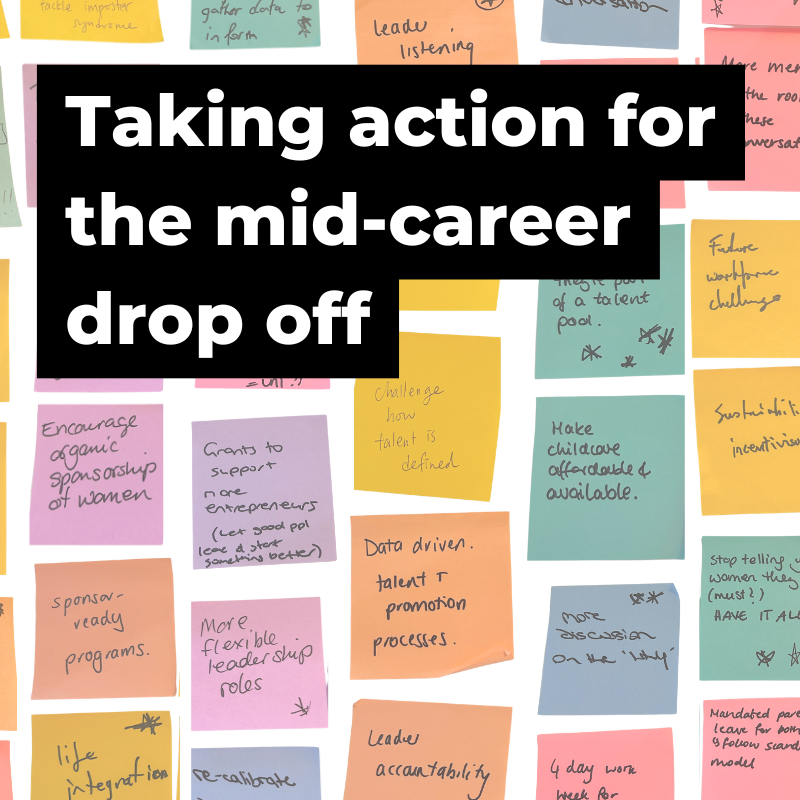
Across Australia, organisations are losing talented women at exactly the career stage when they should be moving into leadership. The mid-career drop-off, the point at which women's representation in leadership pipelines starts to shrink rather than grow, is one of the most costly and preventable talent challenges facing Australian businesses today. In March 2026, EVEN. convened a group of People and Culture leaders in Sydney, from major Australian organisations across infrastructure, financial services, professional services, and aviation to identify the most practical, feasible actions to address it. This is what they found.
Key takeaways:
Hold "stay interviews" with talented women before they decide to leave
Shift from mentoring to sponsorship - women need advocates, not advisors
Normalise flexible leadership and equal parental leave for all parents
Ask women directly what they need to progress, and act on it
Break the "ideal worker" norm by measuring outcomes, not presence
Why the mid-career drop-off is happening
Across Australia and globally, the data tells a worrying story. Women in leadership are leaving their companies faster than they are being promoted in, creating a net drain on representation at exactly the moment it should be growing. Progress toward gender balance is slowing or reversing as a result. Time to take action.
This month in Sydney, we brought together a group of People and Culture leaders to discuss the mid-career drop-off of talented women.
Participants represented organisations responsible for employing tens of thousands of people across Australia, including leaders from major national and global companies in infrastructure, financial and professional services, and aviation. They came armed with first-hand experience of the leadership pipeline challenges facing major organisations today, and ready to contribute solutions.
We also heard from leadership expert and EVEN coach, Kylie Fuller, who highlighted that mid-career women often recalibrate their view of their careers in response to the model of the "ideal worker" or the "ideal leader", which assumes constant availability, narrow career paths, and limited flexibility.
Many talented women anticipate future conflict between leadership expectations and life realities. This can lead to what Kylie described as anticipatory attrition.
Kylie also pointed to the need for leadership pipeline investment to be broader, more democratised, and less focused on a select few who've 'already made it'. Leadership trajectories are strongly shaped by who organisations choose to sponsor, back, and invest in. Broadening the playing field creates much healthier pipelines.
This was a room full of experts, and here at EVEN, we couldn't miss the opportunity of their collective insight and experience. We asked them what they would do about the mid-career drop-off. A long list of ideas were identified, with solutions spanning the immediate and the systemic, reflecting the complexity of the challenge.
The group then voted on the most practical and feasible actions that could be taken immediately to stem the mid-career drop-off. We're pleased to share them below.
Tell your talented women they are valued
Do not assume that talented women know they are valued. Explicitly and deliberately naming a woman's value, her contribution, and the organisation's investment in her future sends a signal that no performance rating or pay review alone can replicate. Here are the most feasible actions the group identified.
Have “stay” interviews with talent you want to keep
The ritual of an exit interview is cemented into work processes, it's time to do the same for "stay" interviews. Development and performance conversations between managers and direct reports are a must, but a "stay" interview is purely focused on 1:1s with talent and ensuring they understand they are seen as talent.
Managers can use language similar to this: "Your capability is valued at this organisation. We see your value now and into the future. We appreciate your contribution to x, y, z. It has made a significant impact to the business, your effort and expertise is truly valued. I'd like to talk to you about how you see the future of your career in this organisation. I want to explore how we can support your career ambitions."
Create sponsorship opportunities for women
Women don't need more mentors, they need sponsors and visibility of their talent for career progression. Sponsors use their personal capital to advocate for women and their career. While a mentor is someone who has knowledge and will share it with you, a sponsor is a person who has power and will use it for you. Sponsorship is so often left to chance but it can be a highly effective method to help those who seek to progress their careers.
When a sponsor advocates on a woman's behalf, it can sidestep some of the penalties women face when they push for their own advancement. Research shows that women who self-promote at work risk a backlash that men typically do not. A sponsor absorbs that risk, using their own credibility and networks to open doors that would otherwise stay closed.
Ask women what they really need to progress
Assumptions are made about what women need to progress. Talk to your women, gather data, and understand what they're seeking to progress their careers. This could be flexibility, it could be opportunities for stretch and visibility, it could be clearer progression pathways, it could be removing barriers to leadership.
Ask women what they want and take action, and treat this as an ongoing listening practice. Regular, lightweight check-ins signal that this is a live commitment, not a box-ticking exercise. And when you act on what you hear you demonstrate that women's voices help shape the organisation.
Bring men into the gender equity conversation
At EVEN we believe life and work can be even, men are not the enemy. Men want work and life that is more even too as gender equity positively impacts their lives and careers. Below are the most feasible actions the group identified to bring more men in to help solve the mid-career drop off.
Include men in the conversation about equity
Invite men to events, meetings and conversations about creating equity and getting even. Welcoming men, their curiosity and their desire to improve work environments for everyone can be encouraged.
What can this look like? It might be a simple communication exercise, "everyone is welcome to this session", creating norms around extending invitations to everyone instead of just women, or identifying your normtrepreneurs, people who actively model new norms for others, who can signify to others new ways of managing the action towards equity.
Consider what men can do at home
As renowned economist Claudia Goldin says "When couple equity is abandoned, gender equality in the workplace tends to follow... The problem is both how work in the labor market is remunerated and how work and caring in the household are divided by gender.."
Organisations can make it structurally easier and culturally normal for men to share the load at home. This means encouraging men to take up flexible working arrangements, parental leave and modelling it from the top.
Provide parental leave for both parents
Provide the same amount of paid leave to both parents, regardless of gender. Replace terms like "primary/secondary carer" with "parental leave for all parents" to encourage uptake by men. Make leave 'Use It or Lose It' for fathers and non-birthing parents.
Research consistently shows that when fathers take extended leave early in a child's life, the division of care at home becomes more equal and stays that way.
Break the norm of the "ideal" worker
The "ideal worker" norm did not emerge by accident. It was built into the architecture of organisations designed around a world where one person worked and another person managed the home. That world is largely gone, but the norms it created have proven remarkably stubborn. They show up in expectations around availability, visibility, and linear career progression that disadvantage anyone whose life doesn't conform to that original, narrow template. Below are the most feasible actions the group identified to break the norm of the ideal worker.
Create flexible leadership models
There’s a growing trend for job-share arrangements, even in the top job. Netflix, Spotify, Comcast and Oracle all have a co-CEO model in place. With businesses growing in complexity how could new models of leadership flow into all levels of leadership?
Job-sharing could work for team leaders, managers, and senior executive levels too, with the right conditions in place. Clear accountability frameworks, shared performance metrics, and a measurement focus on output rather than presence. Flexible leadership can be a genuine career pathway, not a workaround for those who need it.
Re-calibrate how work success is measured
The norm of the ideal worker who is always available, always efficient, always responsive sounds a lot like AI. It's time to redefine what good work looks like when there are AI team members to consider. Shifting success metrics toward outcomes and impact, what was delivered and what difference it made, rather than presence, hours logged, and response times, creates space for people to work in ways that are both effective and sustainable.
The mid-career drop-off is not inevitable
Whilst the data of the mid-career drop off is confronting, here at EVEN we want to stress, it's not an unsolvable problem. There are feasible actions we can take now, step-by-step, that can change the future of women in leadership.
The actions identified here are not theoretical. They are feasible, they are grounded in real experience, and have already been implemented in organisations across Australia.
The mid-career drop-off is costing organisations talent they cannot afford to lose. Take action now with small, feasible actions for big long-term impact for women and the businesses they work for.