
The Women in Leadership Pipeline Illusion
More women are in the workforce than ever before, in Australia the percentage of working women is 51%, but when you get to the top of organisations, representation of women drops to 22%.
It’s not because women are less ambitious. It’s not because they’re less qualified. It’s because the path to leadership is full of compromises that doesn’t account for the life, career and leadership complexity women are wading through to be able to get to the top.
Understanding the Leadership Pipeline Illusion
For years, organisations have been told that the answer to gender equity in leadership is simple: hire more women. The logic appears sound. Increase the number of women entering organisations, create a larger pool of future leaders, and over time representation at senior levels will improve.
Yet despite decades of investment, many organisations continue to see the same pattern emerge. Women enter organisations in strong numbers. They perform well. They progress through early and mid-career roles. And then, somewhere along the path to senior leadership, the pipeline narrows.
The assumption that a larger pipeline will naturally produce more women leaders is what we call the Leadership Pipeline Illusion. It is an illusion because leadership progression is not simply a matter of supply.It is shaped by organisational systems, leadership norms, talent processes, career timing, life complexity, visibility, sponsorship and opportunity.
The challenge is not that organisations lack talented women. The challenge is that too many organisations continue to operate as though leadership progression is a neutral process when, in reality, it is deeply influenced by the way leadership itself is defined, recognised and rewarded.
Collective expertise in action
This May in Melbourne, EVEN brought together a group of senior People and Culture leaders to explore the leadership pipeline illusion, to gather the insights and actions that can work to fix the leaky pipeline.
Participants represented organisations responsible for employing tens of thousands of people across Australia, including leaders from major national and global companies in infrastructure, construction, financial services, energy and utilities.
The Pipeline doesn’t leak equally
One of the observations from EVEN’s discussion with senior People and Culture Leaders was that women are rarely dropping out of a leadership pipeline because of a single event. It’s because of a cumulative series of experiences, such as:
assumptions made about her ambitions, now she’s a mother
inflexible work environments & always on cultures
subtle signals that leadership looks a certain way
At EVEN’s Leadership Pipeline Illusion event, we started by exploring some of the common narratives EVEN hears from mid-career women:
“I’m exceeding targets, but I’m told my confidence is what’s holding me back.”
“I’m heading off on parental leave. I’ll think about next steps when I’m back.”
“I need to step back from my leadership role, it’s too much right now.”
“I can’t see a way to senior leadership with everything I’ve got going on right now.”
“I don’t think senior leadership is for me, I can’t see how I’d make it work.”
We asked the experts in the room: what would you say to these common narratives women share? What do they need to hear? What can’t they see from where they are standing?
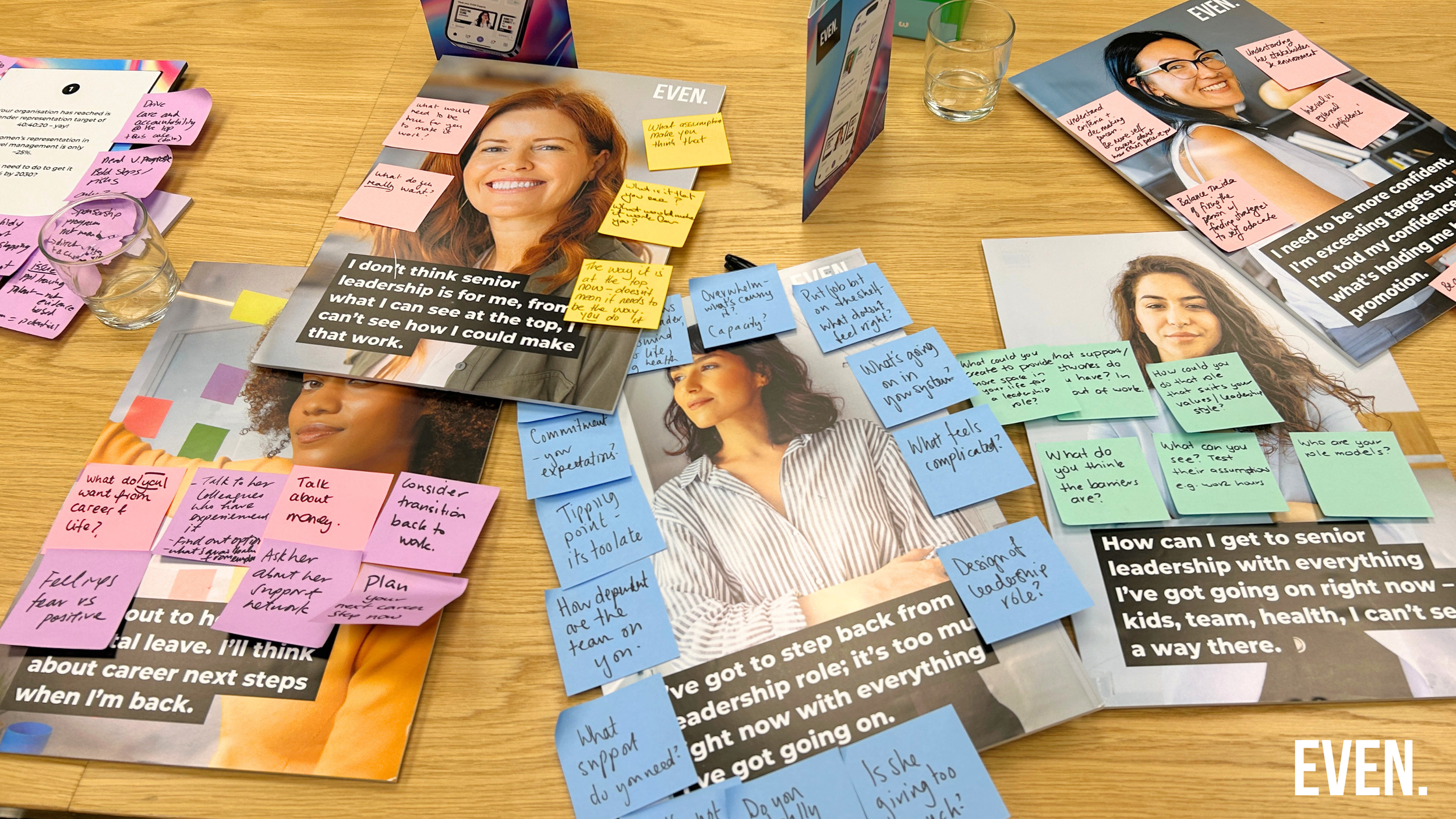
These are the leadership and career moments, decisions and narratives causing the leadership pipeline illusion. They are system challenges, which individual women have to grapple with and internalise as personal decisions about progression and career.
The collective expertise in the room recognised that behind every step up through the leadership pipeline, there was a system requirement needed.
Women who stay in the pipeline and who advance through it report the importance of:
a sponsor willing to advocate
clarity on progression pathways for new types of leader
role models who showed leadership could look different and include life
a conversation about parental leave that happened before it was too late
a clear picture of how decisions about talent actually get made.
Solutions to the women in leadership pipeline problem
The way the leadership pipeline illusion appears is multifaceted, no organisation’s challenges will be the same. Here at EVEN, we believe the solutions to the pipeline problem already exist in the knowledge, experience, and judgement of the people working closest to it.
We posed common pipeline scenarios and asked the experts what organisations could do differently to fix the leaky pipeline. The actions shared below are based on experience, they’re tried and tested within organisations across Australia and demonstrate real ways to increase the pipeline of talented women moving into leadership.
Pipeline Challenge 1: Getting executives on board to stop the leaky pipeline
You’ve set ambitious gender targets for women into leadership roles, and the ELT are going to be active advocates. Women represent less than 25% of the workforce. The next level of executives and senior leaders are novices at this. What do you need to do to get this very important stakeholder group to mobilise?
Actions identified:
Regularly share the data, what gets measured gets managed
Identify where women are underrepresented and why, then go deeper
Educate on systemic barriers and bring lived experience stories into the room
Use reverse mentoring to build empathy and understanding from the inside
Make gender equity a measure in leadership scorecards, accountability requires consequence
Build balanced shortlists and insist on them
Drive sponsorship of women into senior roles, active, named sponsorship, not goodwill
Pipeline Challenge 2: Women are leaving the organisation at mid-career
Your organisation invests in early career talent with structured progression. However, women are disproportionately dropping out at the first executive leader level, typically in the 35–44 age bracket. When you raise this with the ELT, they respond: ‘Women are just leaving to have kids — not much we can do.’ How do you respond?
Start with facts: get the data on where, when, and why women are leaving
Conduct stay and exit interviews with rigour, understand the lived experience
Challenge the narrative: parental leave does not explain mid-career departure at leadership levels
Define what success looks like at the first executive level, and audit whether that definition is equitable
Shift the ELT from observers to owners of this problem
Pipeline Challenge 3: Increase women’s representation to 40% in 3 years
“Your organisation has reached its gender representation target of 40:40:20, but women’s representation in mid-level management is only 25%. What do you need to do to get it to 40% by 2030?”
Actions identified:
Get clear on why mid-level representation is low before designing solutions
Shift from mentorship to active sponsorship with direct accountability
Actively support women stepping into mid-management, not just waiting for them to apply
Audit the role design at mid-level leadership, the ‘sandwich’ layer is often the least well-supported and most demanding
Make bold, data-driven interventions, cautious incremental steps will not close a 15-point gap in three years
Pipeline Challenge 4: Visibility & Recognition
“Women are evaluated on their competence. Men are evaluated on their potential. You’re tasked with growing the leadership pipeline of women by progressing women who already work at the organisation. How do you generate more opportunities for visibility and recognition?”
Actions identified:
Create structured stretch opportunities and assign them with equity in mind
Name women’s contributions explicitly, in rooms they are not in
Build sponsorship programs that give women access to networks and decision-makers
Audit who is getting high-visibility projects and why
De-bias the potential assessment process, define potential objectively, not subjectively
Leadership readiness signals need a refresh
When thinking of actions to fix the leaky leadership pipeline, the way we define, assess and signal leadership readiness must come under the microscope. Who gets seen as "ready”, who gets sponsored into stretch roles, who gets read as a safe bet for leadership. What are the signals of leadership readiness within organisations and how does it play out for women?
The models of leadership so many of us hold in our mind are masculine. So many traits and behaviours of leadership – confidence, decisiveness, assertive, courageous etc. - are associated as male. It leaves a woman with tricky decisions to make throughout her career if she is to move into senior leadership. If she is to be confident, decisive, assertive and courageous as a leader, she has to find a way to do this without appearing masculine, without violating the gender stereotypes in her way. An incredibly difficult, almost impossible task!
How can organisations identify leadership readiness without placing women under greater, uneven scrutiny?
Define leadership readiness criteria explicitly
For every leadership level, be precise about what leadership potential and readiness for the next role looks like in concrete, behavioural terms. What would someone need to have demonstrated? What would it look like in practice? How would a manager know they are seeing it? If the criteria cannot be written down clearly, they are vibes and ripe for bias.
Capture objective measures of potential
Performance can be measured objectively, but what about leadership potential? In 2024, Benson et al found there’s significant noisiness in measuring leadership potential for women due to the leadership stereotyping mentioned above. The research, exploring how the typical 9-box approach to measuring performance and potential for talent, found there is gender bias in potential ratings due to subjective assessments of potential. To minimise and de-bias potential ratings the recommendation is to focus on what people have actually done and how they have done it stretch assignments completed, decisions made under pressure, teams built and developed, cross-functional problems solved. Move away from holistic ‘potential’ ratings and toward specific, evidenced capability markers.
Find all the opportunities to demonstrate leadership readiness
Help people managers identify opportunities for stretch roles, high-visibility projects, and cross-functional assignments for their team, and ensure women have the opportunity to engage with these, to demonstrate their leadership readiness.
The leadership pipeline is not a supply issue
Organisations are not short of capable, ambitious women. We see that the organisations making the greatest progress are not waiting for more women to enter the pipeline. They are examining how talent is identified, developed, sponsored and promoted once women are already inside it.
Organisations that go one step further by re-examining what the model of leadership is for 2026 and beyond will reap the benefits. The leading lights are developing new models and archetypes of leadership, recognising the full complexity of modern careers, modern lives and modern leadership - for all genders.
It’s time to stop fixing women. It’s time to stop asking women to fit into a mould not built for them. At EVEN, we believe leadership is undergoing a profound redefinition. The old model asked leaders to separate work from life, certainty from vulnerability, and performance from humanity.
The emerging model asks leaders to integrate. To lead while navigating complexity, caring responsibilities, health challenges, uncertainty and change. The organisations that recognise this shift earliest will not only build stronger pipelines of women leaders, they will build stronger leadership for everyone.